





- Vaughn A. Wamsley
- Last updated:
- Personal Injury
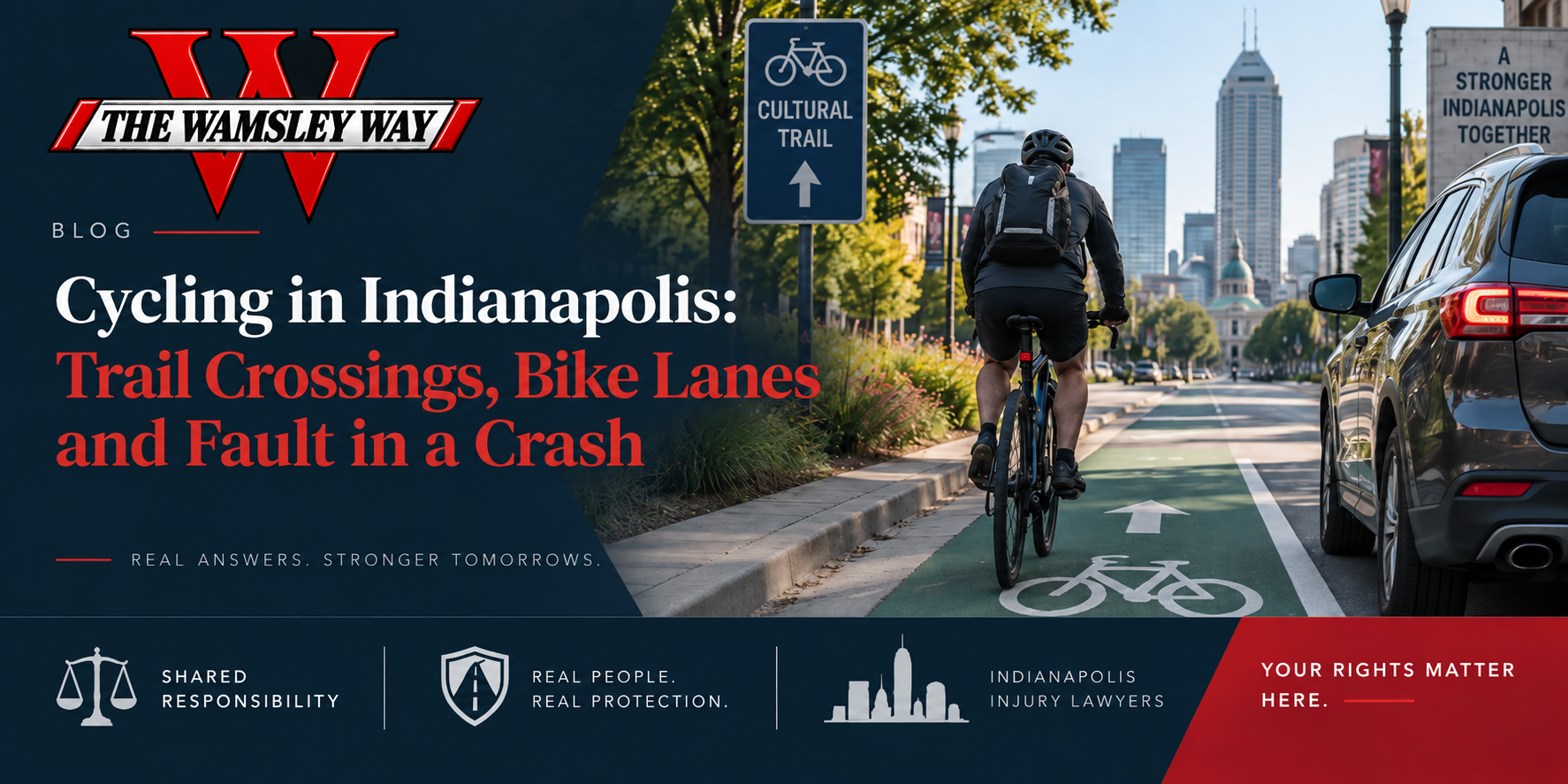
Indianapolis has built one of the more extensive urban trail networks in the Midwest, and cycling here has grown accordingly. So have the crashes, and they follow patterns that are predictable enough to be worth understanding.
The legal position of a cyclist in Indiana is stronger than many riders assume, and it depends on establishing facts that disappear quickly.
Cyclists Have the Rights and Duties of Drivers
Indiana treats a bicycle as a vehicle for most purposes. A cyclist on a roadway has the same rights as a motorist and is subject to the same rules.
That means a cyclist is entitled to use the lane, entitled to be yielded to where a driver would be, and entitled to expect drivers to observe traffic control devices.
It also means a cyclist must obey signals and signs, ride with traffic rather than against it, signal turns, and use lights and a rear reflector when riding at night. Violating those rules supports a comparative fault argument.
Trail Crossings Are the Recurring Hazard
The most consistent conflict point in Indianapolis is where a trail crosses a road at grade.
Drivers approaching a trail crossing often do not anticipate a cyclist traveling at speed, and cyclists often assume a driver has seen them. The Monon Trail, in particular, crosses numerous streets as it runs north through the city into Carmel and beyond, and those crossings regularly result in collisions.
Fault at a trail crossing depends on how the crossing is controlled — a stop sign facing the trail, a signal, a marked crosswalk, or nothing at all. It also depends on sight lines, which are frequently obstructed by vegetation or parked vehicles.
Where sight lines were obstructed by something a property owner or the city was responsible for maintaining, responsibility may extend beyond the driver.
Passing and the Three-Foot Rule
Indiana requires motorists overtaking a cyclist to pass at a safe distance, and the statute specifies a minimum clearance.
Where a driver passed too closely and caused a crash, or forced a cyclist off the road without contact, that violation supports the claim directly.
The no-contact scenario is worth noting. A cyclist who swerved to avoid a close pass and crashed has a claim against the driver, even though the vehicles never touched; proving it depends on witnesses or camera footage, since there is no physical evidence of contact.
Group Rides and Trail Traffic
Indianapolis trails carry mixed traffic — cyclists, runners, walkers, dogs, children, and increasingly electric scooters and bicycles.
Collisions between trail users happen, and they are ordinary negligence claims rather than motor vehicle claims, which means coverage is a genuine problem. A homeowner or renter policy may respond, and many trail users have no applicable liability coverage at all.
Speed differentials are the recurring cause. An electric bicycle traveling well above the pace of surrounding traffic, or a group riding in formation on a crowded path, creates conditions where a small error can lead to a serious collision.
Dooring
Opening a vehicle door into the path of a cyclist is a specific and common cause of serious injury, particularly downtown and in areas with on-street parking.
The person opening the door bears responsibility for doing so safely. A cyclist riding a reasonable distance from parked cars is riding lawfully, and a driver who opened a door without looking cannot reasonably argue the cyclist should have anticipated it.
These crashes produce severe injuries because the cyclist is thrown forward with no opportunity to react, frequently into a travel lane.
Road Defects and Claims Against the City
A substantial share of cycling injuries involve nothing but the road surface — a pothole, a broken pavement edge, an unmarked utility cut, a raised or missing drain grate.
A claim against a governmental entity is possible but difficult. Indiana requires notice within a short period, considerably shorter than the ordinary limitations period, and missing it bars the claim.
The claim also requires establishing that the entity knew or should have known of the defect and had reasonable opportunity to repair it. Prior complaints, service requests, and the age of the defect are the evidence that matters.
Where the defect resulted from utility work or private construction, a claim against the contractor may be considerably stronger and is not subject to the same notice requirements or immunity considerations.
Injuries and Bicycle Damage
Cycling injuries skew serious because there is no structural protection, and the recurring pattern involves the head, collarbone, wrists,s and hips.
Collarbone fractures are among the most common and are frequently treated as minor, when in fact they can require surgical fixation and produce lasting limitation. Head injuries are the most consequential and the most frequently underestimated at the scene.
The bicycle itself is also a recoverable loss, and modern bicycles can be expensive. Replacement value, not depreciated value, is what should be sought, along with damaged clothing, helmets, computers, and accessories.
A damaged helmet is both evidence and a loss. It demonstrates impact forces and supports the injury account, which is a reason not to discard it.
Helmets and the Fault Argument
Indiana does not require adult cyclists to wear helmets. Not wearing a helmet does not make a cyclist responsible for a crash, since a helmet has no bearing on how a collision occurred.
What defendants argue instead is that helmet non-use increased the injuries, which is a damages argument rather than a liability one. How that argument is treated depends on the circumstances and the applicable law, and it should not simply be conceded.
Cyclists who wear helmets and other protective equipment remove the argument entirely, which is a practical benefit in addition to the obvious one.
Where These Crashes Happen
Cycling collisions concentrate in predictable locations, and knowing the pattern helps establish what happened.
Intersections account for a substantial share, particularly when a driver turns across a cyclist traveling straight. Right-hook collisions, where a vehicle passes a cyclist and then turns across their path, are among the most common and most serious.
Left-cross collisions, where an oncoming driver turns across a cyclist, are equally frequent and produce severe injuries because the impact is direct.
Parking lot entrances and commercial driveways are locations where collisions occur when a driver exiting fails to look for a cyclist on the adjacent path or sidewalk.
Each of these has a recognizable pattern of evidence, and reconstruction frequently establishes what happened more reliably than either party’s recollection.
Riding on Sidewalks and Paths
Whether a cyclist may ride on a sidewalk in Indiana is generally governed by local ordinance rather than state law, and it varies between municipalities in the metro area.
This matters because riding where prohibited supports a comparative fault argument. It also matters because a cyclist on a sidewalk approaching a driveway or intersection is in a position drivers do not expect, which affects the analysis of who should have seen whom.
Riders should confirm the rules where they ride rather than assume them, and after a crash, it is worth establishing what was actually permitted rather than conceding the point.
At the Scene
- Call police and insist on a report, even where injuries seem minor
- Photograph the roadway, any defect, the vehicle, your bicycle and the damage
- Preserve the bicycle and helmet without repairing them, since both are evidence
- Get contact details for witnesses
- Download and save any cycling computer or phone data recording the ride
- Seek medical attention the same day, particularly for any head impact
Ride data is frequently decisive, and Vaughn A. Wamsley preserves it early. Speed, position, and the exact moment of impact, recorded by a cycling computer or phone, answer questions that would otherwise be argued about, and are generally more reliable than anyone’s recollection.
Deadlines apply here as elsewhere. Indiana generally allows two years for a claim against a private party, and far less where a governmental entity is involved. A cyclist injured by a road defect faces the shorter of the two, which is why it’s important to establish who maintains the roadway early.
If you were injured cycling in the Indianapolis area, call Vaughn A. Wamsley. Camera footage and roadway evidence both have a short life.
About the Author

Vaughn A. Wamsley
Vaughn A. Wamsley is the owner and founder of the law office of Vaughn A. Wamsley, an Indiana personal injury law firm.