





- Vaughn A. Wamsley
- Last updated:
- Accidents
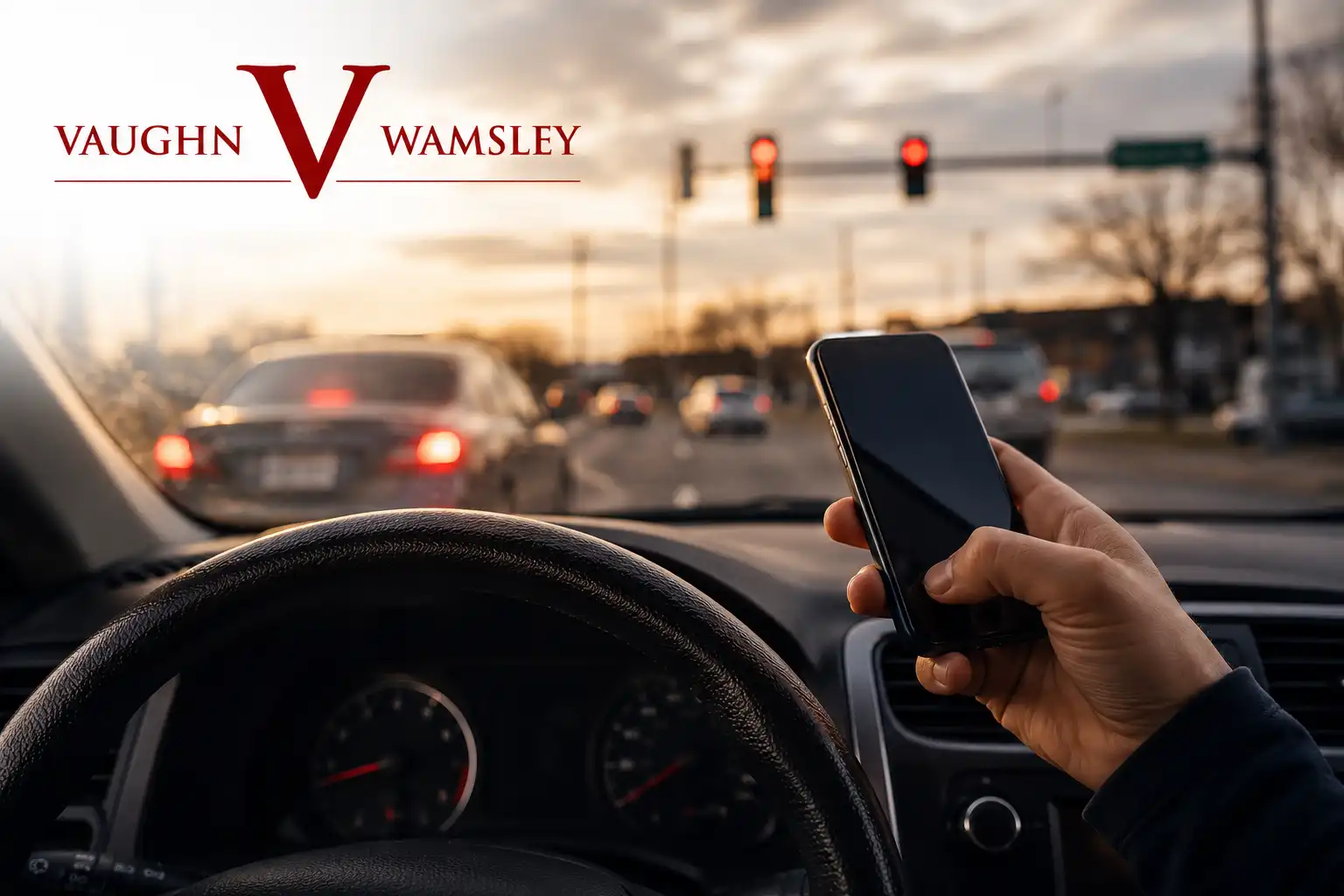
A driver who glances at a phone for five seconds at highway speed travels the length of a football field without watching the road. That single habit is behind a large share of the crashes we see across Indianapolis. Indiana’s hands-free law was designed to change that habit, but distracted driving still causes serious wrecks on our streets and highways every day. If a distracted driver hit you, the law gives you tools to hold that driver accountable, and understanding how the statute works can strengthen your claim.
What Indiana’s Hands-Free Law Actually Says
Indiana Code 9-21-8-59 prohibits a driver from holding a telecommunications device while a vehicle is in motion. The only exceptions are hands-free or voice-operated technology and calls made to report an emergency to 911. The law took effect on July 1, 2020, after Governor Eric Holcomb signed it with broad bipartisan support in the General Assembly.
The statute closed a gap left by Indiana’s original texting ban from 2011, which the Seventh Circuit Court of Appeals found too narrow to enforce. The hands-free law is broader. It does not matter whether a driver is texting, scrolling social media, or simply holding the phone to check a notification. If the device is in the driver’s hand while the vehicle is moving, the driver is in violation.
Officers can pull a driver over solely for holding a phone. This is known as primary enforcement, and it gives law enforcement more direct authority to stop distracted driving before it causes a crash. Drivers under 18 with a probationary license face an even stricter standard. Under Indiana’s Graduated Driver’s License system, young drivers cannot use a telecommunications device at all while driving, even with hands-free technology.
A violation is a Class C infraction and carries a fine. Since 2021, the Indiana Bureau of Motor Vehicles has also added points to a driver’s record for the offense, which can affect insurance rates well beyond the initial ticket.
Why the Law Has Not Solved the Problem
Passing a law and changing driver behavior are two different things. Indiana Criminal Justice Institute leadership has compared the shift away from handheld phone use to the decades it took to normalize seatbelt use, describing it as a genuine culture change rather than a quick fix.
Crash data reflects that slow shift. In the first couple of years after the hands-free law took effect, the total number of crashes and the number involving a distracted driver actually rose before beginning to decline in 2023 and 2024. Every April, during Distracted Driving Awareness Month, Indiana State Police and local agencies run the Indiana Safer Roads Campaign, a high visibility enforcement effort backed by the Indiana Criminal Justice Institute specifically targeting handheld phone use.
National research backs up why the law matters. According to the National Safety Council and National Highway Traffic Safety Administration data, states with hands-free laws have seen traffic fatalities drop by an average of 16 percent within two years of enactment. Independent studies have also found that crash risk runs two to six times higher when a driver is manipulating a phone behind the wheel compared to when they are not.
How Distraction Shows Up in Real Crashes
Distraction rarely shows up on a police report as its own category. It usually hides behind another label. A crash described as a lane departure, a failure to yield, or a rear-end collision may actually trace back to a driver who was looking at a phone instead of the road. Rear-end collisions are especially common, since a distracted driver often fails to notice slowing or stopped traffic in time to brake. Intersection accidents follow a similar pattern, since a driver checking a phone may miss a light change or a car with the right of way.
Drivers involved in a crash rarely admit to phone use at the scene, and an officer’s initial report does not always capture what was happening on the device in the moments before impact. Building a strong distracted driving claim often requires digging past the police report. Cell phone carrier records, in-vehicle infotainment logs, and app usage data can all establish what a driver was doing at the exact moment of the crash, even when the driver denies it.
What This Means for Your Claim
Indiana follows a modified comparative fault rule, so establishing that the other driver was distracted can directly affect how much compensation you recover. If a driver was holding a phone in violation of the hands-free law at the time of the crash, that violation can serve as strong evidence of negligence.
You do not have to prove a phone violation to hold a negligent driver accountable. A driver can still be liable for a distracted driving crash even without cell phone records, based on how the crash happened, witness accounts, and the pattern of damage to the vehicles involved. That said, phone records and device data, when available, make a claim considerably stronger and harder for an insurance company to dispute.
Steps to Take After a Distracted Driving Crash
- Call 911 and request that an officer document the scene.
- Get medical attention right away, even if injuries do not seem severe at first.
- Take photos of both vehicles, the road, and any visible injuries.
- Get contact and insurance information from the other driver and any witnesses.
- Avoid giving a recorded statement to any insurance company before speaking with an attorney.
- Contact an Indianapolis car accident lawyer as soon as possible so evidence such as phone records can be requested before it disappears.
How We Help After a Distracted Driving Accident
Our team has represented Indianapolis accident victims for over 30 years, and we know how insurance companies try to minimize distracted driving claims. We investigate every angle, including rear-end collisions and intersection accidents where distraction is often the hidden cause. When the evidence supports it, we pursue phone records and other digital evidence to prove what really happened.
Vaughn Wamsley understands what it means to be seriously hurt by another person’s carelessness, since he survived a serious accident of his own. That experience shapes how our firm treats every client who walks through our door. You do not pay us unless we win your case.
If a distracted driver hit you in Indianapolis, Carmel, or anywhere in central Indiana, contact us for a free consultation. See our case results to learn how we have helped other accident victims recover the compensation they deserved.
Frequently Asked Questions
Is it illegal to hold my phone at a red light in Indiana?
Yes. Indiana’s hands-free law applies any time the vehicle is in motion, and current enforcement treats a stop at a red light as part of that same period of operation. Holding a phone while stopped at a light still puts you at risk of a citation.
What is the fine for violating Indiana’s hands-free law?
A violation is a Class C infraction. It carries a fine, and since 2021 the Indiana Bureau of Motor Vehicles has also added points to the driver’s record, which can raise insurance premiums.
Can I still recover compensation if the other driver denies using their phone?
Yes. You do not need a confession or an admission from the other driver. Evidence such as the crash pattern, witness statements, and in some cases phone carrier records or vehicle data can establish distraction even when the driver denies it.
Does Indiana’s hands-free law apply to hands-free calling and GPS use?
The law allows the use of hands-free or voice-operated technology, including Bluetooth calling and mounted GPS devices. It only prohibits holding the device in your hand while driving.
Are teen drivers held to a different standard?
Yes. Drivers under 18 with a probationary license under Indiana’s Graduated Driver’s License system cannot use a telecommunications device at all while driving, even with hands-free technology.
How long do I have to file a claim after a distracted driving accident in Indiana?
Under Indiana law, most personal injury claims must be filed within two years of the accident. Waiting too long can put your right to compensation at risk, so it is best to speak with an attorney as soon as possible.
About the Author

Vaughn A. Wamsley
Vaughn A. Wamsley is the owner and founder of the law office of Vaughn A. Wamsley, an Indiana personal injury law firm.