





Under Indiana’s dog bite law, an owner is automatically liable only when the dog bites someone performing a legal duty, such as a mail carrier. For most other victims, the owner is liable if they knew or should have known the dog was dangerous or failed to use reasonable care in controlling it. Most claims must be filed within two years. An Indianapolis dog bite lawyer can tell you which rule applies.
Many people assume Indiana holds dog owners responsible for every bite. The reality is more complicated. Indiana combines a narrow strict liability statute with the traditional one-bite rule and ordinary negligence law, and the right rule can decide whether you recover anything at all. This guide explains each path to liability, the defenses owners and insurers raise, and the steps that protect your claim. If you were bitten in Marion County, our Indianapolis dog bite lawyer page explains how we handle these cases locally.
The Short Answer: Indiana Is Not a Pure Strict Liability State
About half the states make dog owners strictly liable for almost any bite. Indiana is not one of them. Instead, Indiana law starts from a presumption that domestic dogs are harmless, a principle the Indiana Supreme Court reaffirmed in its 2003 decision in Poznanski v. Horvath. A victim overcomes that presumption in one of three ways:
| Path to Liability | Who It Usually Applies To | What the Victim Must Show |
|---|---|---|
| Statutory liability (Ind. Code § 15-20-1-3) | Mail carriers, police officers, and others bitten while carrying out a duty required by state or federal law | The dog bit without provocation while the victim was acting peaceably and doing that duty. No prior viciousness is required. |
| Owner knowledge (the one-bite rule) | Guests, neighbors, passersby, and most other victims | The owner knew or should have known the dog had a dangerous tendency, such as prior bites, lunging, or aggressive behavior. |
| Negligence | Any victim harmed by careless handling of a dog | The owner failed to use reasonable care, such as ignoring a leash law, failing to restrain the dog, or leaving a child unsupervised with it. |
Most real cases turn on the second and third paths, so it is worth understanding how each one works.
When an Owner Is Automatically Liable Under Indiana Code § 15-20-1-3
Indiana’s dog bite statute protects people who must enter a property or area because the law requires them to be there. Under Indiana Code § 15-20-1-3, if a dog bites a person without provocation while that person is acting peaceably and carrying out a duty imposed by Indiana law, federal law, or U.S. postal regulations, the owner is liable for all resulting damages. It does not matter whether the dog ever behaved viciously before or whether the owner knew of any danger.
This protection most often applies to mail carriers, police officers, animal control officers, and government inspectors. It matters in Indianapolis more than in most places. According to U.S. Postal Service rankings reported by Axios, Indianapolis recorded 30 dog attacks on postal workers in 2023, ranking 12th among U.S. cities, up from 21 attacks in 2022.
The One-Bite Rule: Proving the Owner Knew
For guests, neighbors, joggers, and most other victims, Indiana applies what is commonly called the one-bite rule. The owner is liable if they knew or should have known the dog had a dangerous propensity. Despite the name, the dog does not need to have bitten someone before. Evidence that can show an owner was on notice includes:
- Prior bites or attacks on people or other animals
- Growling, snapping, lunging, or charging at people
- Complaints from neighbors, mail carriers, or delivery drivers
- Animal control reports, citations, or prior dangerous dog designations
- The owner’s own statements or actions, such as warning visitors to keep away
Neighbors, animal control, or the owner may hold much of this evidence, so you need to gather it early. A dog’s breed alone is generally not enough to prove an owner knew it was dangerous.
Negligence: Owners Must Use Reasonable Care
Even without proof of prior aggression, an owner can be liable for failing to act with reasonable care. Common examples include letting a dog roam loose in violation of a local leash ordinance, failing to fix a broken fence, or bringing an unfamiliar dog into a crowded public space.
Indiana law also treats some conduct as a crime. Under Indiana Code § 15-20-1-4, an owner who recklessly, knowingly, or intentionally fails to restrain a dog that then leaves the owner’s property and bites someone without provocation commits a criminal offense, with penalties that increase for repeat violations and serious injuries. This kind of violation can also support a civil claim.
Children are especially vulnerable. Indiana courts have held that a person supervising a child can be liable if their dog bites that child, even without a history of biting, when they fail to use reasonable care. Our guide to dog bites involving children in Indiana covers these cases in more detail.
Who Else Can Be Liable for a Dog Bite?
Liability is not always limited to the person whose name is on the dog’s license. Depending on the facts, responsibility may extend to someone who was keeping or caring for the dog at the time, such as a dog sitter, a relative, or a boarding facility. Landlords are a harder case. Indiana courts generally hold a landlord responsible only when the landlord knew about the dog’s dangerous tendencies and retained control over the area where the bite happened, such as a shared hallway, parking lot, or common yard.
Defenses Dog Owners and Insurers Raise
Expect the owner’s insurance company to look for a reason to reduce or deny your claim. The most common defenses include:
- Provocation. The insurer may argue you hit, teased, cornered, or startled the dog. Provocation is a complete defense under the statute and a major factor in other claims.
- Trespassing. An owner may claim you had no right to be on the property. Mail carriers, delivery drivers, and invited guests typically have a lawful reason to be there.
- Comparative fault. Indiana’s Comparative Fault Act reduces your recovery by your share of fault and bars recovery entirely if you are found more than 50 percent at fault.
- No notice. In one-bite cases, the owner will often claim the dog had never shown aggression. Witnesses and records test that claim.
Children receive added protection here. Under long-standing Indiana law, very young children are generally treated as incapable of negligence, which limits an insurer’s ability to blame a child for provoking a dog.
What Dog Bite Claims Are Worth and Who Pays
Most dog bite claims are paid through the owner’s homeowners or renters insurance policy. According to the Insurance Information Institute and State Farm, U.S. insurers paid $1.86 billion in dog-related injury claims in 2025 across 28,450 claims, averaging $65,450 per claim. In Indiana specifically, State Farm reported paying $7.4 million on 112 dog-related claims in 2022, placing Indiana among the top 10 states for these claims that year.
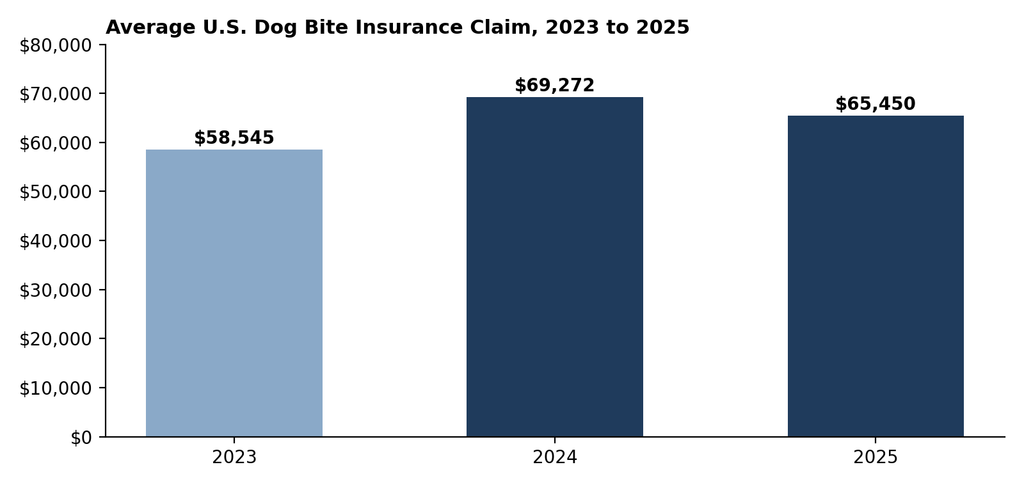
Source: Insurance Information Institute and State Farm.
Averages blend minor bites with severe attacks, so they don’t predict any single case. Facial injuries, scarring, nerve damage, infections, and emotional trauma, especially in children, can push a claim well above the average.
Not sure which rule applies to your bite? Vaughn A. Wamsley has more than 30 years of experience representing injured people across Indiana, and his firm has helped more than 10,000 clients. Call 317-846-1080 for a free consultation. You pay nothing unless we win.
Steps That Protect Your Indiana Dog Bite Claim
- Get medical care right away. Dog bites carry a high risk of infection, and prompt treatment also documents your injuries.
- Identify the dog and its owner, and get contact information for any witnesses.
- Report the bite to Indianapolis Animal Care Services or your local animal control agency to create an official record.
- Photograph your injuries as they heal, along with the location where the bite happened.
- Avoid giving a recorded statement to the owner’s insurance company before speaking with an attorney.
Knowing the warning signs of a dog attack can also help you describe what happened, since a dog’s behavior before a bite often becomes key evidence of what the owner should have known.
Indiana’s Deadline for Dog Bite Claims
In most cases, Indiana gives injured people two years from the date of the bite to file a personal injury lawsuit. If the dog belonged to a government agency, such as a police K-9, much shorter notice deadlines may apply. Waiting also makes it harder to find witnesses and prior complaint records, so the sooner an attorney begins investigating, the better.
Frequently Asked Questions About Indiana Dog Bite Law
Is Indiana a strict liability state for dog bites?
Only in limited situations. Indiana Code § 15-20-1-3 makes owners liable regardless of the dog’s history when the dog bites someone who is carrying out a duty required by state or federal law, such as a mail carrier. For most other victims, Indiana follows the one-bite rule and general negligence principles.
What is the one-bite rule in Indiana?
The one-bite rule means an owner is generally liable when they knew or should have known their dog had a dangerous tendency. Despite the name, the dog does not have to have bitten someone before. Growling, lunging, snapping, or prior complaints can all show the owner was on notice.
Can I still recover if the dog had never bitten anyone before?
Possibly. Even without prior aggression, an owner can be liable for negligence, such as letting the dog run loose in violation of a leash law or failing to supervise a child around the dog. If you were bitten while performing a legal duty, prior behavior doesn’t matter.
Can a landlord be held responsible for a tenant’s dog?
Usually only in narrow circumstances. Indiana courts generally require proof that the landlord knew about the dog’s dangerous tendencies and controlled the area where the bite happened, such as a shared hallway or common yard.
How long do I have to file a dog bite claim in Indiana?
In most cases, you have two years from the date of the bite to file a personal injury lawsuit in Indiana. Claims involving government entities can require written notice much sooner, so speak with an attorney quickly.
Who pays for a dog bite injury in Indiana?
In most cases, the owner’s homeowners or renters insurance policy covers dog bite liability, up to the policy limits. Some policies exclude certain breeds or dogs with a bite history, so an early review of your coverage matters.
What Happens When You Call Vaughn A. Wamsley
When you call 317-846-1080, our team will ask a few simple questions about the bite, including where it happened, who owns the dog, and what medical treatment you have received. We will schedule a free consultation to review your injuries, any photos or animal control reports, and what is known about the dog’s history. You will leave knowing which Indiana liability rule applies to your case, what your claim may be worth, and what to do next to protect it.
Talk to an Indiana Dog Bite Lawyer
Vaughn A. Wamsley represents dog bite victims throughout Indianapolis, Carmel, and the rest of Indiana on a contingency fee basis. Whether you were bitten on a neighbor’s porch, in a park, or on your mail route, we can help you understand your rights and pursue full compensation. If you live in Hamilton County, visit our Carmel dog bite lawyer page to learn more.
Call 317-846-1080 for a free consultation. There is no fee unless we win your case.
