





The legal tint in Indiana is 30% visible light transmission (VLT) with no more than 25% reflectance on the front door windows and the rear back window. Windshield tint is allowed only above the AS-1 line. Drivers with a certified medical need may go darker. If a driver’s tint blocked their view and you were hurt, a lawyer can review the evidence for free.
Reviewed by Vaughn A. Wamsley, Attorney at Law. Licensed in Indiana since 1989, with more than 35 years handling car accident and personal injury cases across Indianapolis, Carmel, and Central Indiana. Last legally reviewed November 2026.
Indiana law sets the legal tint limit at 30%, meaning the glass and film together must let at least 30% of visible light pass through the windows the statute names. Indiana Code 9-19-19-4 contains that rule, and it has not changed since the last amendment in 2018. This guide explains exactly which windows the rule covers, what common tint percentages mean in real driving, what a tint ticket costs, and why dark tint can matter after a crash.
Indiana Tint Limits at a Glance
The table below summarizes what the statute allows on a standard passenger vehicle. Every rule here comes directly from IC 9-19-19-4 unless noted otherwise.
| Window | Indiana Rule | Where It Comes From |
| Windshield | Tint allowed only on the uppermost part, no lower than the AS-1 line; reflectance of 25% or less | IC 9-19-19-4(c)(1), (d) |
| Front door side windows | At least 30% VLT and no more than 25% reflectance | IC 9-19-19-4(c)(3) |
| Side wings (vent windows) | At least 30% VLT and no more than 25% reflectance | IC 9-19-19-4(c)(2) |
| Rear back window | At least 30% VLT and no more than 25% reflectance | IC 9-19-19-4(c)(4) |
| Rear passenger door windows | Not listed in subsection (c) | IC 9-19-19-4(c) |
| Factory tint and privacy glass | Exempt if compliant with federal FMVSS 205; proof must be carried in the vehicle | IC 9-19-19-4(a) |
| Medical exemption | Darker tint allowed with an Indiana physician or optometrist certificate, renewed annually and kept in the vehicle | IC 9-19-19-4(b) |
What Does 30% VLT Actually Mean?
VLT stands for visible light transmission. It measures how much visible light makes it through the window. A lower number means a darker window. A 30% reading means 70% of the light is blocked before it reaches your eyes, or before an officer or another driver can see inside your car.
The number that matters is the combined reading of the glass and the film together, not the film by itself. Factory glass already blocks some light. When a shop installs a 35% film over glass that is slightly tinted from the factory, the combined reading can land below 30%. That is one of the most common ways drivers end up with an illegal window after paying for what they thought was a legal film.
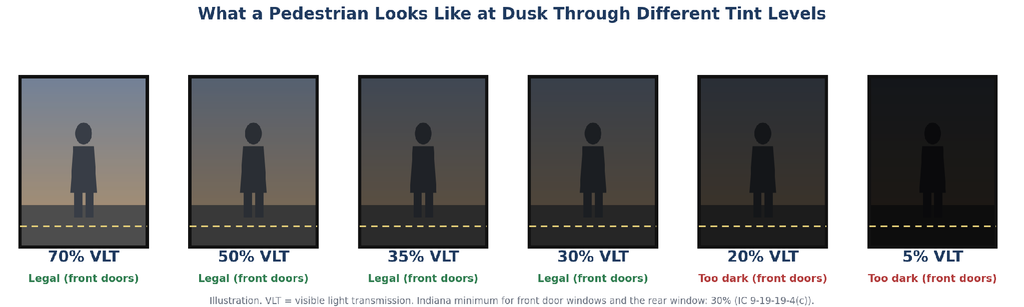
Illustration of how a pedestrian in dark clothing fades from view as tint gets darker. Indiana requires at least 30% on the front door windows and rear back window.
Federal rules set the baseline for the glass a driver needs to see through. Under Federal Motor Vehicle Safety Standard 205, glass used for driving visibility must let through at least 70% of light. Indiana allows aftermarket film to take the front door windows down to 30%, which is less than half of that federal baseline.
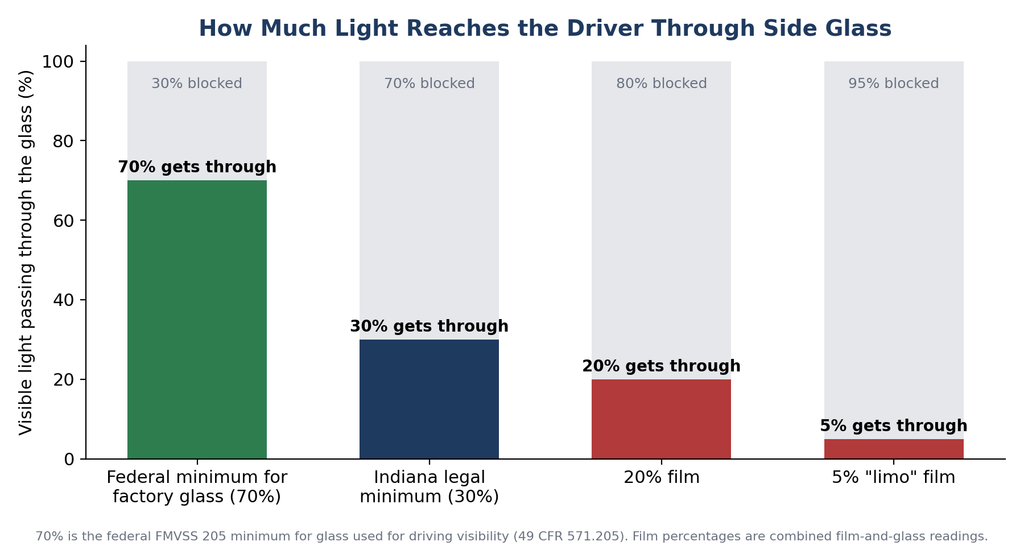
How much visible light reaches the driver at each tint level. Source: 49 CFR 571.205 (FMVSS 205) and IC 9-19-19-4.
Which Windows the Law Covers, and the One Most Guides Get Wrong
Most online tint guides say Indiana applies 30% to every window except the windshield. The statute is more specific than that. Subsection (c) lists four places: the windshield, side wings, side windows that are part of a front door, and the rear back window. Rear passenger door windows do not appear on that list.
That does not mean anything goes on the back doors. Officers still enforce the law based on what they see, a stop is still allowed to check compliance, and a reputable installer will usually match the rear doors to the rest of the car. The practical takeaway is simple. Keep the front doors and back glass at 30% or lighter, and ask your installer to put the film and glass readings in writing for every window.
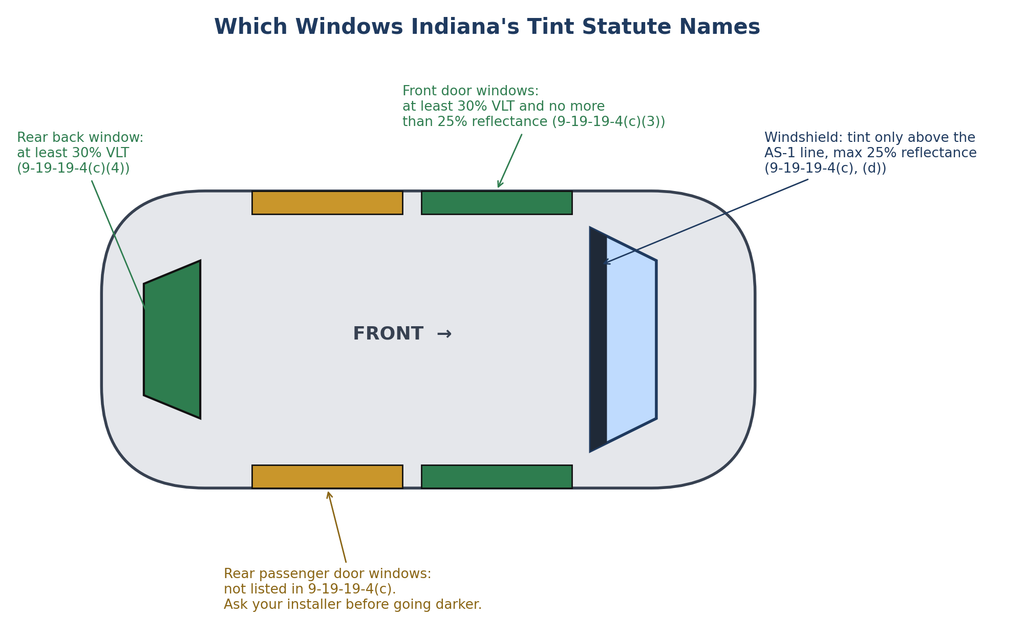
Which windows IC 9-19-19-4(c) names. Front door windows and the rear back window carry the 30% VLT and 25% reflectance limits.
Is 5%, 15%, 20%, or 35% Tint Legal in Indiana?
These are the questions Hoosier drivers ask most. Each answer below applies to the front door windows and the rear back window, the windows the statute expressly names.
| Tint Level | Legal on Front Doors and Rear Window? | Why |
| 5% (limo tint) | No | Blocks about 95% of light, far below the 30% minimum |
| 15% | No | Below the 30% minimum |
| 20% | No | Below the 30% minimum |
| 30% | Yes, if the combined reading is 30% or higher | Meets the minimum exactly; factory glass can push the reading under |
| 35% | Yes | Lighter than the minimum, with room for factory glass |
| 50% and lighter | Yes | Well within the limit |
Reflectance matters too. A mirrored or metallic film can be illegal even at a legal darkness level if it reflects more than 25% of visible light. If you are shopping for film, ask for a product that lists both its VLT and its reflectance.
Factory Tint and SUV Privacy Glass
Many SUVs, minivans, and pickups leave the factory with dark privacy glass behind the driver. That glass is not aftermarket film. IC 9-19-19-4(a) exempts a manufacturer’s tinting that complies with federal standard FMVSS 205, but the statute also says proof from the manufacturer, supplier, or installer must be carried in the vehicle. Keeping a copy of the window sticker or a manufacturer statement in your glove box can save you an argument at the roadside.
Medical Exemptions for Darker Tint
Indiana allows darker tint for a driver who owns the vehicle and needs to be shielded from the sun for medical reasons, or who regularly drives a passenger with that need. The rules in IC 9-19-19-4(b) and (e) are specific:
- A physician or optometrist licensed in Indiana must certify the medical reason.
- The certification must stay in the vehicle at all times.
- The certification must be renewed every year.
- A shop may legally install darker film only after the customer gives the installer that statement.
If the certificate has lapsed, the exemption is gone. An expired certificate in the glove box will not stop a ticket.
Tint Tickets: Fines, Traffic Stops, and Searches
A driver who violates the tint statute commits a Class C infraction under IC 9-19-19-7. Under Indiana’s infraction statute, IC 34-28-5-4, a Class C infraction carries a fine of up to $500, plus court costs. A shop that applies illegal tint for a customer without a medical statement faces a Class A infraction under IC 9-19-19-8, which can reach $10,000.
| Who Is Cited | Classification | Maximum Fine |
| Driver operating a vehicle with illegal tint | Class C infraction (IC 9-19-19-7) | Up to $500, plus court costs |
| Person who applies illegal tint for someone else | Class A infraction (IC 9-19-19-8) | Up to $10,000 |
Can an officer pull you over just for tint? Yes. Subsection (f) of the statute allows a stop to determine compliance. In Sanders v. State, 989 N.E.2d 332 (Ind. 2013), the Indiana Supreme Court held that an officer who reasonably believes tint is too dark has grounds for the stop, even if the tint later proves legal. That same subsection, though, draws an important line. Police may not search or detain the vehicle, its contents, the driver, or passengers solely because of a tint violation.
How Indiana Compares to Neighboring States
Indiana is one of the more permissive states in the Midwest for front window tint. Drivers who cross into Ohio, Illinois, or Kentucky can be cited under that state’s law, even if their car is legal at home.
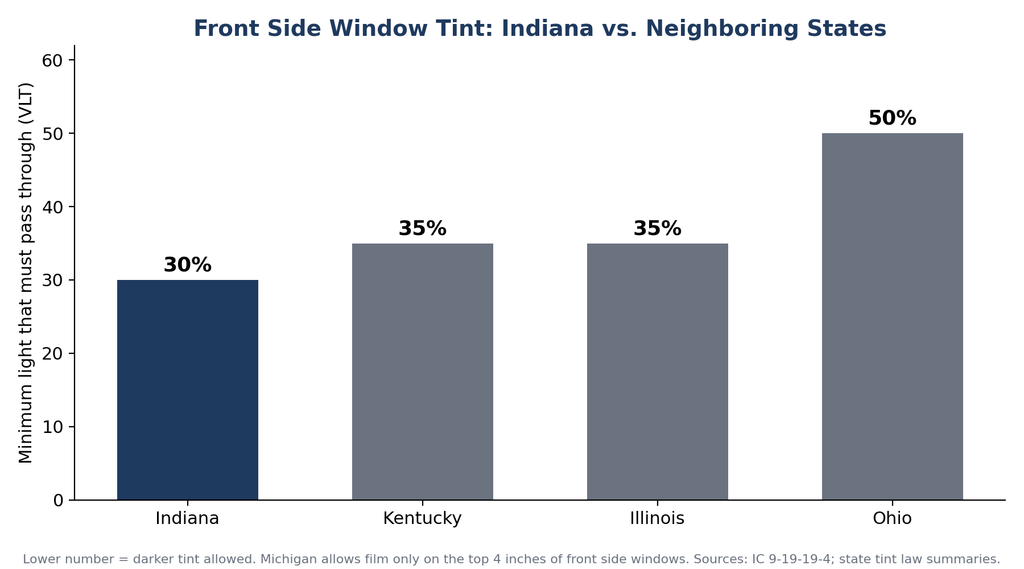
Front side window minimums: Indiana 30%, Kentucky 35%, Illinois 35%, Ohio 50%. Michigan allows film only on the top 4 inches of the front side windows.
Can Dark Tint Affect a Car Accident Claim in Indiana?
This is where tint stops being a ticket question and becomes an injury question. Dark tint does not cause crashes on a sunny afternoon. The research points to a narrower but serious problem: low light, low-contrast targets, and older eyes.
- NHTSA’s 1991 Report to Congress on window tinting cited research finding 25% to 35% reductions in drivers’ ability to detect low-contrast targets in simulated twilight when 40% glass replaced 76% glass.
- A Virginia study prepared for state transportation officials concluded that tint reduces the ability to see targets that are already hard to see through clear glass, and that this becomes a safety liability when light is low.
- In a University of Adelaide study of night driving through tinted glass, older drivers accounted for 178 of the 179 target detection failures, and their reaction times were longer when looking through the tinted window.
- A federal study of rear window film found that detection of a child and roadway debris dropped as light transmission dropped, which matters every time a driver backs out of a driveway or parking space.
Those findings line up with when people get hurt. According to NHTSA, 77% of pedestrian deaths in 2023 happened in the dark. A driver checking a side mirror or turning left through a dark front window at night is exactly the scenario where tint can hide a pedestrian, a cyclist, or a motorcyclist until it is too late. Our Indianapolis pedestrian accident attorneys most often see these crashes at intersections and in parking lots after sunset.
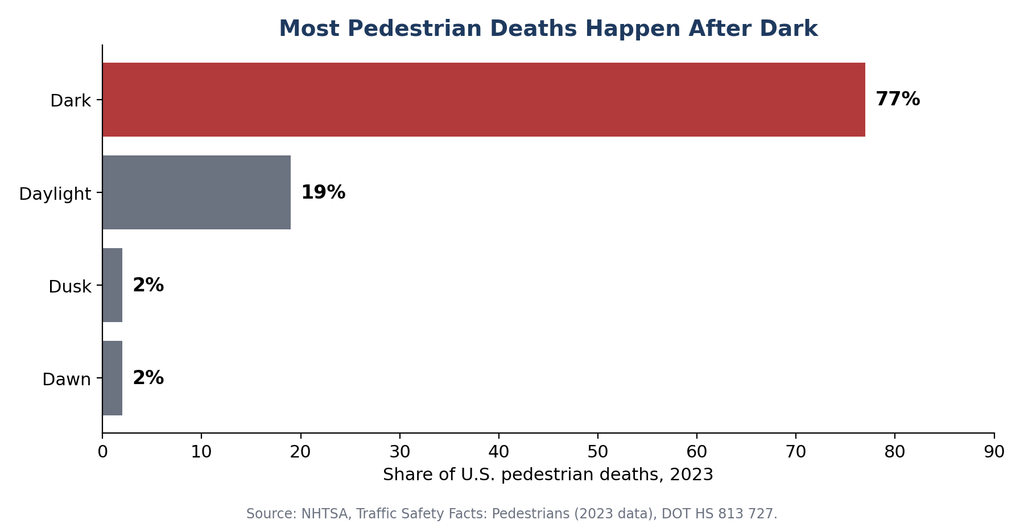
Share of U.S. pedestrian deaths by light condition, 2023. Source: NHTSA Traffic Safety Facts, DOT HS 813 727.
How Tint Fits Into Indiana’s Fault Rules
Indiana uses a modified comparative fault system under IC 34-51-2-6. An injured person can recover damages as long as their share of fault is not greater than 50%, and any award is reduced by that share. Our guide to Indiana’s modified comparative negligence rule walks through how that math works in a real crash claim.
Tint can cut both ways. If the at-fault driver had illegally dark windows and failed to see you, the tint becomes evidence that they could not keep a proper lookout. If you had dark tint, the other driver’s insurer may try to blame your windows for the crash. A tint violation alone does not prove fault. The insurer still has to show that the tint actually played a role in how the collision happened.
“Insurance adjusters love an easy excuse, and dark tint is one of the first things they reach for, whether it is on our client’s car or theirs. When the other driver had limo tint and turned left into a motorcyclist at dusk, we want that window measured and photographed before the car is repaired or sold. When the adjuster tries to blame our client’s tint, we ask a simple question: what exactly could the other driver not see, and when? Most of the time, the tint had nothing to do with it.” Vaughn A. Wamsley
What to Do If a Driver With Dark Tint Hits You
Tint evidence disappears quickly. Film can be peeled off in minutes, and a damaged car may be repaired or sent to auction within days. These steps help preserve it.
| Step | Why It Matters |
| Photograph the other car’s windows at the scene | Shows how dark the glass looked in the same light conditions as the crash |
| Note the time, lighting, and weather | Tint matters most at dusk, at night, and in rain |
| Ask whether the officer measured the tint | Some officers carry a tint meter; a reading in the crash report is strong evidence |
| Request the crash report | The narrative may note tint, visibility, or a citation |
| Send a preservation letter quickly | Asks the other driver and insurer not to remove the film or dispose of the vehicle |
| Get medical care and keep records | Your injuries, not the tint, drive the value of your claim |
You can request your crash report through our free police report request page. If the crash happened at a signal, our article on why traffic cameras matter in Indianapolis accident claims explains how footage can show what each driver could see.
Hurt by a driver who could not see you? Vaughn Wamsley has spent more than 35 years holding careless drivers accountable across Central Indiana, and the firm has recovered more than $100 million for Indiana injury victims. Call (317) 597-1618 for a free case review. You pay nothing unless we win.
Frequently Asked Questions About Indiana Tint Laws
What is the darkest legal tint in Indiana?
For the front door windows and the rear back window, the darkest legal film still lets at least 30% of visible light through the glass and film combined, with reflectance of 25% or less. On the windshield, tint is allowed only above the AS-1 line.
Is 5% tint legal in Indiana?
No, not on the front door windows or the rear back window. A 5% film blocks about 95% of visible light, far below the 30% minimum in IC 9-19-19-4(c). The only exception is a driver with a valid, annually renewed physician or optometrist certification carried in the vehicle.
Is 20% tint legal in Indiana?
No, 20% tint is too dark for the front door windows and the rear back window. Indiana requires at least 30% light transmission on those windows, so 20% film is a Class C infraction unless a medical exemption applies.
Is 35% tint legal in Indiana?
Yes. A 35% film lets more light through than the 30% minimum, so it is legal on the front door windows and rear back window as long as its reflectance stays at or below 25%. Keep in mind that film over factory glass reads darker than the film rating alone.
Can police pull you over just for tint in Indiana?
Yes. IC 9-19-19-4(f) allows an officer to stop a vehicle to check tint compliance, and the Indiana Supreme Court upheld a tint stop in Sanders v. State (2013). The same subsection says officers may not search or detain the car, driver, or passengers solely because of a tint violation.
How much is a tint ticket in Indiana?
A driver tint violation is a Class C infraction under IC 9-19-19-7, which carries a fine of up to $500 under IC 34-28-5-4, plus court costs. Applying illegal tint for someone else is a more serious Class A infraction and can carry a fine of up to $10,000.
Can illegal tint hurt my car accident claim in Indiana?
It can become an argument, but it does not automatically defeat a claim. Indiana uses modified comparative fault, so an insurer must show the tint actually contributed to the crash. You can still recover if your share of fault is 50% or less, with your award reduced by that share.
Do rear passenger windows have to be 30% in Indiana?
IC 9-19-19-4(c) lists the windshield, side windows, front door side windows, and the rear back window. It does not list rear passenger door windows. Many guides say 30% applies to every window, so confirm your vehicle and film with a reputable installer before going darker.
Common Concerns About Calling a Lawyer After a Crash
“I had tint on my own car. Does that ruin my case?”
No. Your tint only matters if the insurer can tie it to how the crash happened. In many collisions, such as a rear-end crash or a driver running a red light, your windows had nothing to do with it.
“My injuries do not seem serious enough.”
Many crash injuries, including concussions and back injuries, get worse in the days after a collision. A free review costs nothing and can tell you whether your claim is worth pursuing before the two-year filing deadline under IC 34-11-2-4 becomes a problem.
“I cannot afford a lawyer.”
The firm handles injury cases on a contingency fee. There is no upfront cost, and there is no fee unless we recover compensation for you.
What Happens When You Call
When you call, a member of our intake team will answer and ask a few questions about where and when the crash happened, who was involved, and what injuries you are dealing with. The call is free, and there is no obligation. If the case is a fit, an attorney will review the details with you and explain your options in plain language. You will leave the call knowing whether you have a claim and what the next step should be.
Keep Reading
If you were hurt in a collision, our Indianapolis failure to yield accident lawyers handle the left-turn and intersection crashes where visibility is most often in dispute. Drivers who want to stay on the right side of Indiana traffic law can also read whether it is legal to drive barefoot in Indiana and the latest Indiana car seat and booster seat rules for 2026. Carmel drivers can reach our Carmel car accident lawyer team directly.
Talk to an Indiana Car Accident Lawyer Today
Vaughn A. Wamsley has been licensed in Indiana since 1989 and has helped Indiana injury victims recover more than $100 million. If a driver who could not see you caused your crash, call (317) 597-1618 for a free, no-obligation case review. You pay nothing unless we win.
