





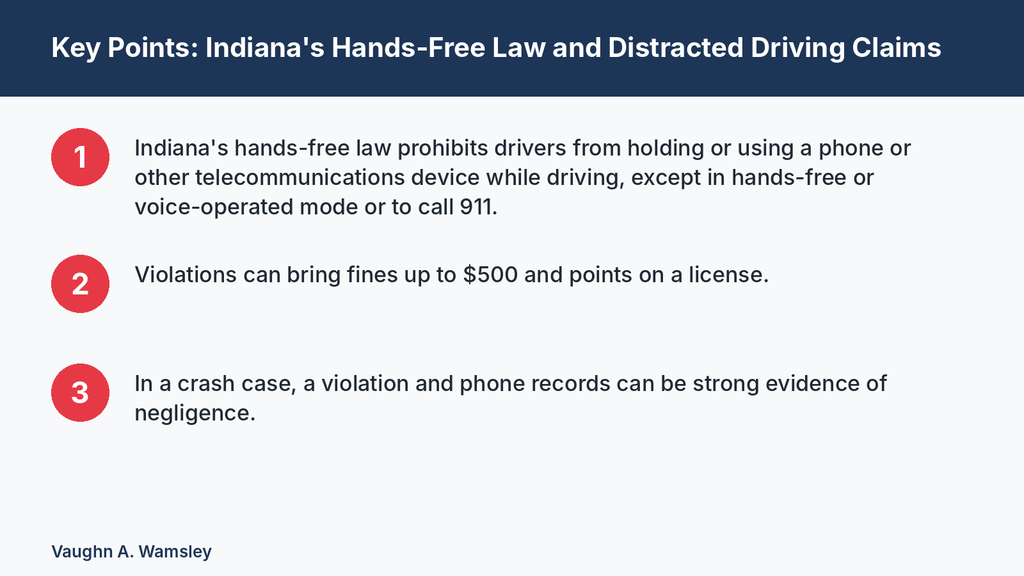
Indiana’s hands-free law prohibits drivers from holding or using a phone or other telecommunications device while driving, except in hands-free or voice-operated mode or to call 911. Violations can bring fines up to $500 and points on a license. In a crash case, a violation and phone records can be strong evidence of negligence.
Reviewed by Vaughn A. Wamsley, Indianapolis personal injury attorney. Last reviewed November 2026.
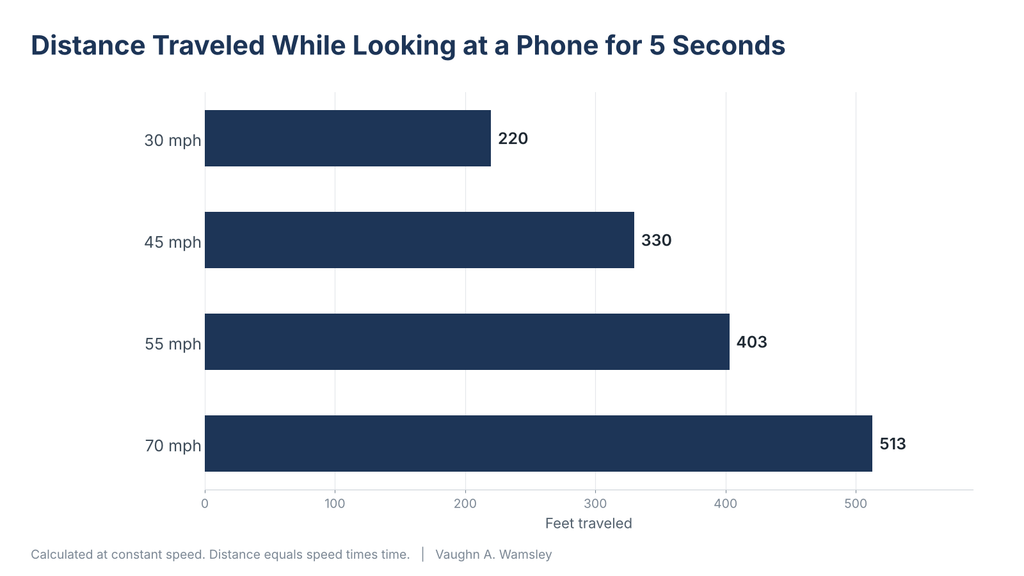
Distracted driving is one of the leading causes of crashes in Indiana. A driver who looks down at a phone for just a few seconds at highway speed travels the length of a football field without watching the road. Since July 1, 2020, Indiana has banned drivers from holding phones while driving.
If you were hurt by a distracted driver in Indianapolis or anywhere in central Indiana, the hands-free law can play an important role in proving your claim.
What the Hands-Free Law Prohibits
Under Indiana Code 9-21-8-59, a person may not hold or use a telecommunications device while operating a moving motor vehicle. That includes:
- Holding a phone to make or take a call
- Typing, reading, or sending texts or emails
- Scrolling social media or watching videos
- Using apps that require handling the phone
Drivers may use a phone in hands-free or voice-operated mode, such as through a dashboard system or a mounted phone with voice commands.
Exceptions to the Law
The law allows a driver to use a phone to call 911 to report a bona fide emergency. Certain emergency responders acting in their official duties are also exempt. Using a phone while lawfully parked is generally not covered, but stopping at a red light still counts as operating a vehicle in traffic.
Penalties for Violations
A violation is a Class C infraction with a fine of up to $500. Indiana also assigns points to a driver’s record for hands-free violations, and drivers who build up too many points within two years can face license suspension. Repeated violations may affect insurance rates as well.
How a Hands-Free Violation Can Affect Insurance Rates
A hands-free citation is a moving violation, and insurers review driving records when policies renew. Many carriers treat a phone violation as a sign of risky driving, which can lead to higher premiums for several years. A second violation, or a violation combined with an at-fault crash, often has a larger effect on rates.
For the at-fault driver in a crash, the bigger financial issue is usually the injury claim itself. For the injured person, the citation is useful evidence. Either way, the violation becomes part of the record that adjusters, attorneys, and juries may see.
How the Law Helps Prove Fault in a Crash
Indiana uses a modified comparative fault system. To recover, you must show the other driver was negligent and that you were not more than 50 percent at fault. Evidence that the other driver was holding or using a phone supports negligence because it shows a failure to pay attention. A citation for violating the hands-free law can be persuasive, though the civil case still must prove that the distraction contributed to the crash.
Attorneys usually build a distraction case in layers. The first layer is timing: phone records that show a call, text, or data session in the seconds before impact. The second is behavior: witnesses or video showing the driver looking down, drifting, or failing to brake. The third is the crash itself: vehicle data and scene evidence that fit a driver who was not watching the road. When these pieces line up, the hands-free violation becomes much harder for an insurer to dismiss.
A citation is not required to prove negligence. Even if police did not write a ticket, the same evidence can show that the driver broke the hands-free rule and caused the crash.
Phone Records as Evidence
Phone records can show calls, texts, and data use at the moment of the crash. Attorneys may request records through a lawsuit subpoena, and in serious cases a forensic expert may review the phone itself. Other evidence can also show distraction:
- Witness statements that the driver was looking down
- Dash camera or traffic camera footage
- Vehicle event data showing no braking before impact
- Statements the driver made at the scene
- Social media posts with timestamps near the crash
Because phone carriers keep detailed records only for limited periods, sending a preservation request early is important.
Damages in Distracted Driving Cases
Injured people may recover medical expenses, lost wages, future care costs, pain and suffering, and property damage. Indiana generally allows two years to file a personal injury lawsuit, as explained in our guide to the personal injury statute of limitations. Claims against government drivers have shorter notice deadlines.
What If You Were Also on Your Phone
Insurance companies often check the injured person’s phone too. If you were using your phone, it may reduce your recovery under comparative fault. Be honest with your attorney so the team can prepare for that argument.
Steps to Take After a Crash With a Distracted Driver
- Call 911 and tell officers if you saw the driver using a phone.
- Ask witnesses for contact information.
- Photograph the scene and vehicles.
- Seek medical care promptly.
- Contact an attorney before giving a recorded statement to the other insurer.
Frequently Asked Questions
Is it illegal to hold your phone while driving in Indiana?
Yes. Indiana bans holding or using a phone while driving, except hands-free use or calling 911 in an emergency.
What is the fine for violating Indiana’s hands-free law?
Up to $500, plus points on your driving record.
Can I use GPS on my phone while driving in Indiana?
Yes, if the phone is mounted and used hands-free or by voice.
Can phone records be used in a car accident case?
Yes. Phone records can be obtained through the legal process and used to show distraction.
How long do I have to file a car accident claim in Indiana?
Generally two years from the crash.
Does a ticket for texting prove the other driver was at fault?
It is strong evidence, but you still must show the distraction contributed to the crash.
Can I use my phone at a red light in Indiana?
No. Stopping at a red light or in traffic still counts as operating a vehicle, so holding or using a phone is not allowed unless you are lawfully parked or calling 911 in an emergency.
Talk to an Indianapolis Car Accident Lawyer
Vaughn A. Wamsley represents people injured by distracted drivers throughout Indianapolis and central Indiana. When you call, our team will ask how the crash happened, what you saw the other driver doing, and what injuries you have, then explain how to preserve phone evidence. Learn more about our Indianapolis personal injury lawyer services.
