





In most Indianapolis trick-or-treat pedestrian accidents, the driver who struck the child or adult is primarily liable because Indiana law requires drivers to use extra caution around children. Depending on the facts, a homeowner, a bar that overserved a drunk driver, a vehicle owner, or a government entity responsible for unsafe roads may share liability.
By Vaughn A. Wamsley, Indianapolis personal injury attorney with more than 30 years of experience representing injured Hoosiers.
Halloween is one of the best nights of the year for Indianapolis families, from crowded sidewalks in Irvington and Broad Ripple to busy subdivisions in Lawrence, Castleton, and the southside. It is also one of the most dangerous nights to be on foot. Children in dark costumes cross streets mid-block, masks limit their vision, and drivers are often distracted, rushing home, or leaving Halloween parties. When a trick-or-treater is hit, families are left with serious injuries and an urgent question: who is legally responsible?
Why Halloween Is So Dangerous for Pedestrians
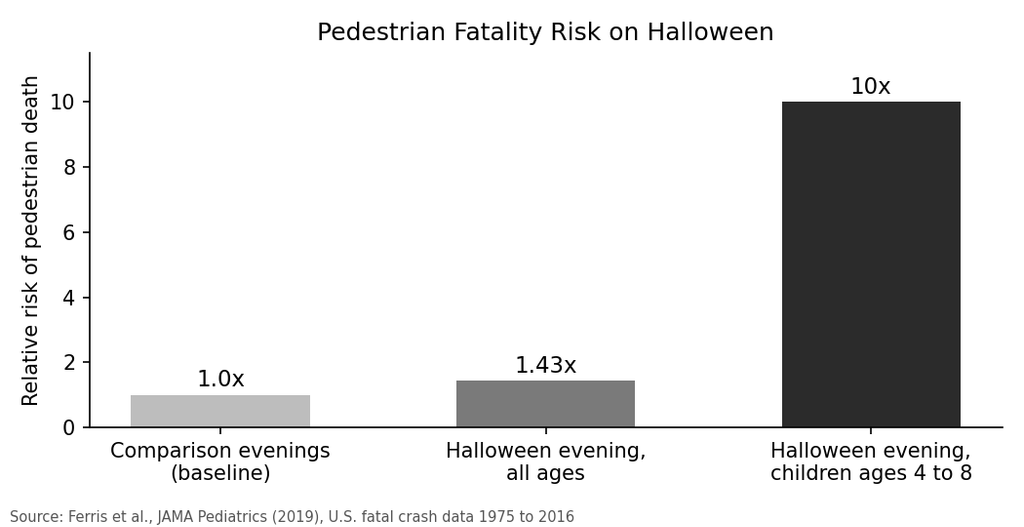
National research confirms what parents fear. A study published in JAMA Pediatrics analyzed four decades of U.S. fatal crash data and found that pedestrians were 43 percent more likely to be killed on Halloween evening than on comparison evenings a week before and after. For children ages 4 to 8, the risk was roughly ten times higher.
Several factors drive that risk. Trick-or-treating overlaps with sunset, so visibility drops quickly. Children move unpredictably, often crossing between parked cars. Costumes are frequently dark, and masks reduce peripheral vision. Meanwhile, some drivers are looking at phones or navigation screens, and others are impaired after parties. These same dangers drive many nighttime pedestrian accidents in Indianapolis, concentrated into a few hours on a single evening.
The Driver: Usually the Primary Liable Party
Indiana law places a clear duty on drivers. Under Indiana Code 9-21-8-37, a driver must use due care to avoid colliding with any pedestrian, sound the horn when necessary, and exercise proper precaution when observing a child on the roadway. On Halloween, when neighborhoods are full of children, a reasonable driver is expected to slow down, scan sidewalks and driveways, and be ready to stop.
Common forms of driver negligence on Halloween include speeding through residential streets, failing to yield at crosswalks, backing out of driveways without checking behind the vehicle, passing a car stopped to let children cross, and distracted driving. A driver who ignores pedestrians in a marked or unmarked crossing may face liability similar to other crosswalk accidents.
When Others May Share Liability
Trick-or-treat crashes do not always involve just one responsible party. Depending on the facts, liability may extend to:
- A drunk or drugged driver’s alcohol provider. Under Indiana’s dram shop law, a bar, restaurant, or other provider that served alcohol to someone it knew was visibly intoxicated may share responsibility if that person then causes a crash. Halloween parties and bar events make this a real concern, as with other drunk driving accidents.
- The vehicle owner or employer. If the driver was working, such as a delivery or rideshare driver, the employer or its insurer may be responsible.
- A property owner. Homeowners who invite trick-or-treaters onto their property must use reasonable care to keep it safe. Unlit steps, broken railings, tripping hazards from decorations, open flames, or an aggressive dog can lead to injuries and premises liability claims, which follow many of the same principles as slip-and-fall accidents.
- A government entity. Broken streetlights, missing sidewalks, or dangerous road design can contribute to crashes. Claims against Indiana government entities require a written tort claim notice within strict deadlines, often 180 days for local governments.
- An event organizer. Organizers of trunk-or-treat events and neighborhood festivals may face liability if traffic control or supervision was inadequate.
Can a Child Be Blamed for Running Into the Street?
Insurance companies sometimes argue that a child who darted between parked cars caused the accident. Indiana law does not judge children by adult standards. Very young children are generally considered incapable of negligence, and older children are measured against what a child of similar age, intelligence, and experience would do.
Even when a child made a sudden move, drivers are expected to anticipate that children may behave unpredictably, especially on Halloween. A child who ran out mid-block is not automatically at fault, and the rules discussed under jaywalking accidents apply differently when the pedestrian is young.
How Indiana’s Comparative Fault Rule Affects Your Claim
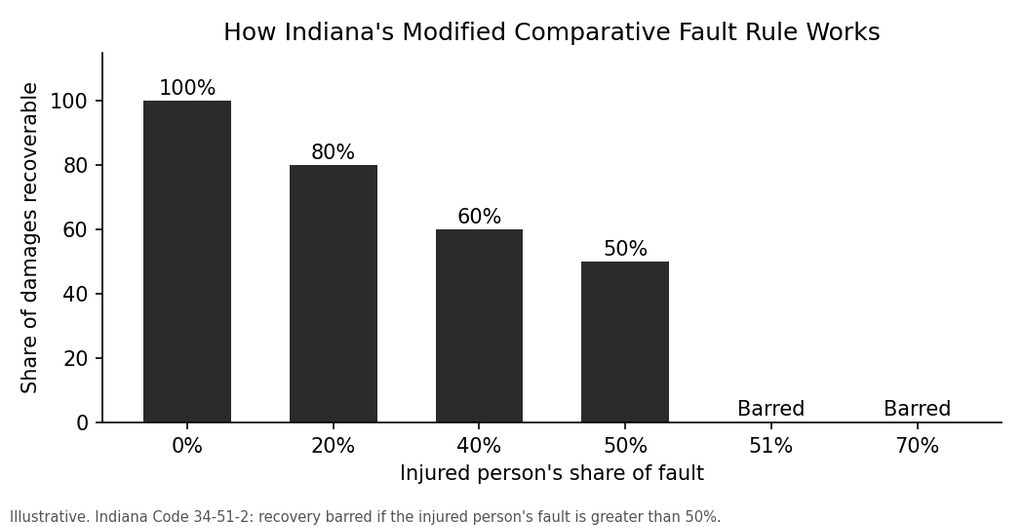
When an adult pedestrian, such as a parent walking with children, is injured, Indiana’s modified comparative fault system applies. An injured person can recover damages as long as their share of fault is not greater than 50 percent, but the recovery is reduced by that percentage. For a deeper look at how fault is divided, see how comparative fault works in Indianapolis accidents.
Insurers often try to inflate a pedestrian’s share of fault by pointing to dark clothing, the absence of a flashlight, or crossing outside a crosswalk. Evidence such as doorbell video, witness statements, and crash reconstruction often tells a different story.
Common Injuries in Trick-or-Treat Accidents
| Injury | Why It Is Common | Long-Term Concerns |
|---|---|---|
| Traumatic brain injury | Children’s heads are often at bumper or hood height | Learning, memory, and behavioral changes |
| Broken legs and pelvis | First point of contact with the vehicle | Growth plate damage in children, surgery, rehabilitation |
| Spinal cord injury | Impact with the vehicle or pavement | Mobility limits, ongoing therapy |
| Internal injuries | Blunt force to the torso | Emergency surgery, hospitalization |
| Burns | Costumes contacting candles or open flames on property | Scarring, skin grafts |
| Dog bites | Excited or frightened dogs at the door | Infection, scarring, emotional trauma |
Injuries to children can take months or years to reveal their full impact, especially brain injuries. That is why it is important not to settle a child’s claim before the long-term effects are understood.
What to Do After a Trick-or-Treat Accident in Indianapolis
- Call 911 and get medical care for the injured person right away, even if injuries seem minor.
- Get the driver’s name, license, insurance, and plate number, and note the vehicle’s make and color.
- Ask neighbors for doorbell and security camera footage before it is overwritten, which can happen within days.
- Collect witnesses’ names and phone numbers, including other parents and trick-or-treaters.
- Photograph the scene, lighting conditions, costumes, the vehicle, and any property hazards.
- Request a copy of the crash report from the Indianapolis Metropolitan Police Department. Learn more about getting a police report.
- Do not give a recorded statement to the driver’s insurance company before speaking with a lawyer.
If the driver fled, report it immediately and preserve every possible video source. Our team regularly handles hit-and-run accidents, where neighborhood cameras are often the key to identifying the driver.
Special Rules When the Injured Person Is a Child
Claims involving children follow different timelines and procedures. In Indiana, the two-year statute of limitations for a child’s own injury claim is generally paused until the child turns 18, but a parent’s claim for medical expenses usually has a shorter deadline. When a claim settles, Indiana courts generally must approve the settlement, and the funds are often protected in a restricted account. Learn more about court approval of minor settlements in Indiana. In the most tragic cases, families may need to pursue wrongful death claims.
Vaughn Wamsley on Halloween Pedestrian Cases
“Every Halloween, I think about how quickly a fun night can change a family’s life. In these cases, the insurance company almost always tries to blame the child for running into the street or the parents for a dark costume. But Indiana drivers have a legal duty to watch for children, and on Halloween night that duty is about as obvious as it gets. We move fast to get the doorbell videos, the witness statements, and the crash data, because that evidence usually shows the driver had time to see the kids and did not slow down.” Vaughn A. Wamsley
Has your child or family member been hurt while trick-or-treating? Vaughn A. Wamsley has more than 30 years of experience fighting for injured Hoosiers, has recovered hundreds of millions of dollars for clients, and has earned more than 200 Google reviews. You pay no fee unless we win. Call 317-846-1080 or see our results.
“Vaughn was a great advocate for my son who was in a motorcycle accident several years ago.” Jeff Banning, client review
Frequently Asked Questions
Can a child be found at fault for a trick-or-treat accident in Indiana?
Indiana courts treat young children differently from adults. Very young children are generally considered incapable of negligence, and older children are judged by what a child of similar age, intelligence, and experience would do, not by adult standards. Even when a child darted into the street, the driver may still be responsible for failing to exercise the extra care Indiana law requires around children.
Who pays if a hit-and-run driver strikes my child on Halloween?
If the driver is never identified, your own auto policy’s uninsured motorist coverage may apply, even though your child was on foot rather than in a car. Report the crash to police immediately and preserve any doorbell or home security video from the neighborhood, which often identifies vehicles in hit-and-run cases.
Can I sue a homeowner if my child was hurt on their property while trick-or-treating?
Possibly. Property owners must use reasonable care to keep their premises safe for people they invite onto the property, and a lit porch and decorations often signal an invitation on Halloween. Claims may arise from unlit steps, broken railings, dangerous decorations, or an aggressive dog, depending on the facts.
How long do I have to file a claim for a child injured on Halloween in Indiana?
Indiana generally allows two years from the date of injury to file a personal injury lawsuit. For a minor’s own claim, the deadline is usually paused until the child turns 18, but a parent’s separate claim for medical expenses typically follows the standard two-year deadline. Acting early also protects evidence like video footage.
Does a settlement for an injured child need court approval in Indiana?
Settlements of a minor’s injury claim generally need approval from an Indiana court, and the money is often placed in a restricted account until the child reaches adulthood. This process protects the child’s recovery.
What if the driver who hit my child had been drinking at a Halloween party?
The driver is responsible for their own conduct, and a drunk driving conviction can strengthen the civil claim. Under Indiana’s dram shop law, a bar, restaurant, or other provider that served the driver alcohol while knowing the driver was visibly intoxicated may also share liability.
Do I need to wait until my child’s medical treatment ends before calling a lawyer?
No. It is better to speak with an attorney early, while video footage, witness memories, and physical evidence are still available. A lawyer can begin preserving evidence while your child focuses on recovering.
Concerns Families Often Raise
“The driver was a neighbor. I do not want to sue someone I know.” In most cases, the driver’s auto insurance company pays the claim, not the neighbor out of pocket. Insurance exists for exactly this situation, and pursuing a claim helps cover your child’s medical care and future needs.
“My child’s injuries seem minor now.” Head injuries and growth plate fractures in children can have delayed or long-term effects. A full medical evaluation and thorough records protect both your child’s health and the claim.
“I cannot afford an attorney.” Vaughn A. Wamsley handles injury cases on a contingency basis. There is no fee unless we recover compensation for you.
What Happens When You Call Vaughn A. Wamsley
When you call, our team will ask what happened, where the accident occurred, who was injured, and what medical treatment has been received so far. We will explain your options, identify every party who may be responsible, and take immediate steps to preserve video footage and other evidence that can disappear quickly after Halloween. You will come away understanding your rights and what comes next.
Talk to an Indianapolis Pedestrian Accident Lawyer
Trick-or-treat accidents are preventable, and when a careless driver or property owner causes harm, Indiana law gives injured families a path to compensation. Learn more about our Indianapolis pedestrian accident lawyers, call 317-846-1080, or contact us to discuss your case.
